
Biodegradable Liquid Mulch for high-value Crops
Plants grow on average 30% bigger
According to a field trial done at UPM by the Universidad de la Republica in Uruguay, eucalyptus saplings planted in the field and treated with Liquid Mulch for high-value crops grow up to 26% taller with stems 50% larger than plants that were not treated with anything. The same plants treated with Liquid Mulch for high-value crops also grew up to 14% taller with stems 29% larger than plants treated with herbicides. This is because of reduced weed competition and increased water retention in the soil.
A field trial in Ontario, at a tree nursery, on native spruce and pine tree saplings found that those trees grew 10% taller with stems 20% larger than trees that were not treated with anything. The smaller increase compared to eucalyptus was because of the slower growth rate of the spruce and pine compared to eucalyptus.

About 85% fewer weeds
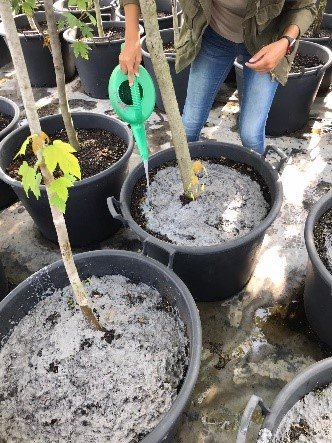
Not only does Liquid Mulch for high-value crops help growers control weeds, but it also helps the desirable plants flourish. This is a picture of Liquid Mulch for high-value crops applied to potted saplings at EarthGen, a tree nursery in Ontario, Canada. The data collected here corresponded well with all the other data that was collected by different institutions, including Cornell University and the University of Guelph, among others. Not only do the pots treated with Liquid Mulch for high-value crops look nicer but the trees are healthier, fuller, and bigger.
In the picture on the left, the lowest application rate of 0.5 Kg/m^2 was used. Even at this, the lowest recommended application rate, the absence of weeds is clearly evident.
In the picture on the right, the weeds crowd out the saplings in numerous pots and the saplings are visibly smaller.
The crust formed by Liquid Mulch for value-added crops prevents weed seeds that onto the treated soil from sprouting because, being exposed to the sun, they dry out.

Water 45% less
Liquid Mulch for high-value crops reduces the amount of water that evaporates from the soil. This is especially important in climates where the sun can quickly dry out the soil and cause stress to the sapling or young vine. This property has been tested by many organizations in many geographies and under many different environmental conditions. Examples of places were this property was tested include: Arizona (USA), Holland (Europe) Ontario (Canada), Quebec (Canada), Santiago (Chile), and Uruguay. All the results agree that Liquid Mulch for high-value crops reduces the rate at which water is lost from the soil by at least 45%.
The mechanism is simple. Liquid Mulch for high-value crops binds with the top 5 cm of soil and forms a crust that decreases the porosity of the soil. This reduces the amount of water that can evaporate through the soil and the water is available to the young plant. However, it still allows the soil to breathe and it allows rainwater and irrigation water to penetrate to the roots, although at a slower rate.

Prevents soil erosion
Since the Liquid Mulch for value-added crops binds with the top 5 cm of soil, it prevents heavy rains from washing the soil away, especially on hills with slopes up to 80 degrees. Also, the rain cannot run under the Liquid Mulch for value-added crops. Since it is bound to the soil the rain cannot wash the soil out from underneath as it can with fabrics and films that lie in top of the soil.
In the picture on the right, Liquid Mulch for value-added crops is being applied on a hill to prevent the rain from washing away the soil from around the trees and to prevent the previously applied wood chips from being washed into the grass. This proved to be very effective because it held everything in place for the entire season.
Liquid Mulch for value-added crops is particularly effective when crops are grown using mounds as it prevents the mounds from being washed flat.

Increases seedling, slip, and sapling survivability
Since Liquid Mulch for value-added crops helps preserve moisture in the soil, seedlings or slips do not dry out as easily and since it reduces competition from weeds, more seedlings or slips survive and thrive better with Liquid Mulch for value-added crops than without.
The picture on the left is of eucalyptus saplings planted during a particularly hot and dry summer in South America. Liquid Mulch for value-added crops was applied at 1 Kg/m^2 and for 1 m^2 around the saplings. The saplings were not watered after planting. No saplings were lost while usually up to 6% of saplings are lost.
Similar results were observed with freshly plant grape vines in Ontario, Canada and in Chile.

Safe! Completely biodegradable, no microplastics, no chemical residues
Liquid Mulch for value-added crops is made from plant polysaccharides. It does contain any petrochemicals or plastics. It does not “fall apart” from solar UV rays or from rain. It is entirely and naturally consumed by the microbes in the soil. There are no residues or left-over films that need to be removed.
Health Canada has confirmed that Liquid Mulch for value-added crops does not need to be registered. It can be used along waterways since it poses no danger to the environment. In Canada it has been used frequently in conservation lands.
Likewise, people applying the Liquid Mulch for value-added crops do not need to wear special protective equipment.